
AI Insights: Key Global Developments in May 2026
Welcome to the May 2026 Ed. of our global AI update.
This month, AI clearly moved beyond just new model launches. While GPT-5.5 and other major updates grabbed attention, the bigger story was how companies and governments are now building AI into their everyday systems, work, and decision-making.
From cybersecurity and cloud platforms to business operations and software, May showed that AI is becoming a real part of how things run. It’s not just about what AI can do anymore, it’s about how it is being used at scale.
Here are the key developments that defined this shift.
Anthropic- Agents for Financial Services

Anthropic launched a major push into financial services with ten ready-to-run AI agent templates designed specifically for some of the sector’s most time-intensive workflows.
These templates target practical, high-value tasks such as building pitchbooks, screening Know Your Customer (KYC) files, and managing month-end financial close processes. Rather than requiring firms to build from scratch, Anthropic is offering these as deployable tools through Claude Cowork, Claude Code plugins, and cookbooks for Claude Managed Agents.
This significantly reduces implementation time, allowing financial teams to move from experimentation to real deployment in days instead of months. Beyond templates, Anthropic also expanded Claude’s integration into Microsoft 365 through add-ins for Excel, PowerPoint, Word, and soon Outlook, enabling professionals to move seamlessly across applications while retaining context.
For example, financial analysis performed in Excel can directly inform presentations in PowerPoint without repeated prompting. Anthropic further strengthened this ecosystem with new connectors and MCP apps, giving Claude governed, real-time access to financial data providers and embedding third-party financial tools directly inside Claude’s workflow.
Overall, this launch marks a clear shift from general-purpose AI assistance toward specialized, production-ready financial agents, showing how Anthropic is targeting one of the world’s most process-heavy industries with practical AI infrastructure.
Source- Anthropic
OpenAI- GPT-5.5 Model Launch

OpenAI unveiled GPT-5.5. The company describes GPT-5.5 as a major advance in “intuitive” and “agentic” AI.
It combines code-generation prowess with deep reasoning and can autonomously execute multi-step tasks. In internal benchmarks, GPT-5.5 leads previous models on coding and reasoning tests. Impressively, it runs about as fast as GPT-5.4 despite these gains, and uses fewer input tokens on common tasks. OpenAI also highlights “self-debugging” aspects: early versions of Codex were used to tune and even debug the GPT-5.5 training itself.
The model is rolling out to ChatGPT Plus/Pro/Enterprise users and soon to the API.
Overall, GPT-5.5 marks a shift toward models that not only generate code or text, but can plan and iterate across longer workflows. OpenAI emphasizes that these capabilities require new safeguards as well – the announcement highlights safety and governance improvements alongside performance. In sum, GPT-5.5 sets a new bar for AI coding assistants and general reasoning tools, solidifying OpenAI’s lead in “AI agents” that manage complex tasks.
Source – OpenAI
OpenAI - GPT-5.5 Instant (ChatGPT Default)

OpenAI updated ChatGPT’s default (“Instant”) model to GPT-5.5 Instant.
This is a streamlined variant optimized for general users: it delivers “smarter, clearer, and more personalized” responses in everyday chat, without needing a special subscription.
According to OpenAI’s blog, GPT-5.5 Instant greatly improves factual accuracy and conciseness. Internal tests showed 52.5% fewer hallucinated claims (false statements) on high-stakes topics (medicine, law, finance) compared to GPT-5.3 Instant. It also reduced errors by 37.3% on previously problematic dialogs. Beyond text, GPT-5.5 Instant handles images and STEM queries better and learns to use web search when needed for an answer. The net effect is that everyday ChatGPT interactions should feel more reliable and efficient.
Importantly, the tone remains user-friendly: OpenAI says GPT-5.5 Instant maintains ChatGPT’s engaging style but “trim[s] the fluff,” asking fewer needless follow-ups.
In practice, this means quicker, more useful answers for common questions.
Source – OpenAI
EU- AI Act Simplification Agreement

The EU institutions reached a provisional deal to ease some AI Act requirements.
This so-called “Omnibus VII” agreement aligns with the EU’s push to remove unnecessary burdens from companies.
Key changes include delaying enforcement of high-risk AI rules (by up to 16 months, until necessary standards are ready) and extending certain SME exemptions to small mid-caps.
In practice, this means businesses get more time and room to comply. Some minor reductions in obligations were also agreed (e.g. streamlined obligations in a few narrow cases). At the same time, the EU insisted that core protections remain – for example, bans on harmful outputs (like “nudification” tools that alter images) are still upheld.
EU officials said the deal will cut costs and create clearer rules without weakening user safety. For companies, the takeaway is that while the AI Act timeline has eased, they still need to prepare. Audits, documentation, and fairness measures for high-risk AI should be in place even if deadlines shift.
This update shows EU regulators are trying to balance innovation and oversight: the AI Act’s framework stays intact, but firms get more clarity and time during rollout.
Source - Council of the EU
Amazon- Quick & Connect AI Services

At an AWS event on April 28, Amazon unveiled several new AI-powered services for business users.
Amazon Quick (a personal assistant for workers) now has a desktop app (Preview) and broader integrations. The new Quick app brings the assistant to local files and calendars, so users don’t need to open a browser. Quick also added capabilities like generating polished documents, slides, and images from chat commands.
It now connects natively to Google Workspace, Zoom, Airtable, Dropbox, and Teams for direct task automations. Businesses can also build custom apps with Quick (in Preview), allowing the creation of intelligent dashboards and web pages driven by natural language prompts.
Meanwhile, Amazon Connect (AWS’s contact-center platform) was rebranded into four “agentic” solutions.
The new Amazon Connect offerings include:
Connect Customer (the original chat/voice AI agent platform, now with faster setup);
Connect Decisions (agentic supply chain planning tools);
Connect Talent (AI hiring and interview tools); and
Connect Health (AI for patient intake, scheduling, and documentation).
Together, these updates show Amazon embedding AI into core enterprise workflows- Quick aims to boost worker productivity with generative tasks, while Connect’s suite brings AI agents directly into customer service, HR, and operations.
Source – Amazon (AWS News Blog)
6. AWS- Expanded Partnership with OpenAI

AWS and OpenAI agreed to bring the very latest OpenAI models into Amazon Bedrock.
Notably, GPT-5.5 and GPT-5.4 became available via the Bedrock API (in limited preview). This means AWS customers can now query their own data using these frontier models with integrated security and cost controls. AWS also launched Codex on Amazon Bedrock: developers can use OpenAI’s coding assistant (Codex) inside AWS, authenticating with AWS credentials and counting usage against their AWS commitments.
Moreover, AWS introduced Amazon Bedrock Managed Agents (OpenAI-powered) (preview), a turnkey solution for building production-ready AI agents on AWS. These managed agents pair OpenAI models with AWS infrastructure to handle long-running workflows and ensure reliability.
In practical terms, the partnership lets enterprises run OpenAI models (like GPT-5.5) natively on AWS, under AWS’s governance framework. This lowers barriers for firms who want ChatGPT-level AI but need enterprise controls. Early users (e.g. Azure used it for contact centers) have been testing these features.
Overall, the AWS–OpenAI tie-up shows how cloud providers are wrapping up LLMs into their platforms: Bedrock now officially hosts OpenAI’s top models and tools, enabling companies to mix their own data with OpenAI’s intelligence seamlessly.
Source - Amazon (AWS News Blog)
7. IBM - Autonomous Security

IBM announced a suite of AI-driven cybersecurity offerings.
Foremost is IBM Autonomous Security, a multi-agent service that continuously coordinates defense at machine speed. IBM notes that attackers are beginning to use “frontier” AI models to rapidly find and exploit vulnerabilities.
To counter this, IBM Autonomous Security deploys many AI “digital workers” across an organization’s security stack. These agents automatically analyze exposures, enforce policies, detect anomalies, and even remediate threats in real time with minimal human input.
The idea is to turn a fragmented mix of tools into a unified, AI-orchestrated system.
In parallel, IBM Consulting is offering a new Frontier Model Threat Assessment service. This evaluation scans a company’s IT environment for gaps that advanced AI attackers could exploit, identifying AI-specific risks and giving prioritized mitigation steps.
It also suggests interim safeguards where fixes are not ready. Together, these moves recognize that “AI vs AI” is the new battleground. IBM’s pitch is that enterprises now need security programs that auto-respond as quickly as attackers innovate. By embedding AI into both offense and defense, IBM says organizations can keep pace with “agentic” cyber threats.
In short, IBM is positioning AI-powered automation not just as a tool but as the core of cybersecurity, enabling companies to detect and stop AI-enhanced attacks more effectively.
Source - IBM
8. IBM- Red Hat AI Inference & OpenShift Virtualization

IBM launched two new managed cloud services to help enterprises scale AI production and modernize infrastructure.
The first is Red Hat AI Inference on IBM Cloud- a fully managed service that runs AI models in real time with enterprise SLAs. It includes built-in governance controls and can serve high-throughput inference workloads from models like Mistral, Llama 3, and others. The idea is to let companies integrate AI-powered predictions directly into their applications without handling the GPUs or stacks themselves.
The second service is Red Hat OpenShift Virtualization Service on IBM Cloud, which provides a secure, scalable virtualization environment for migrating VM workloads. This helps firms move legacy virtual machine applications into a Red Hat OpenShift (Kubernetes) platform with automated lifecycle management.
Both offerings are delivered as IBM-managed services on hybrid cloud.
According to IBM, these services bridge the gap from AI pilots to production- they give developers a “production-grade” platform for AI inference and a path to modernize old infrastructure at corporate scale.
In effect, IBM is bundling Red Hat’s AI and virtualization tech with its cloud, so enterprises can reliably deploy AI models and simultaneously move toward containerized environments.
The announcement underscores a theme of May 2026: making AI “enterprise-ready.” By offering Red Hat-powered managed services, IBM aims to simplify data scientists’ lives and ensure corporate governance, letting businesses innovate with AI faster and more securely.
Source - IBM
9. Anthropic & Partners - New AI Services Firm

Anthropic joined with Blackstone, Hellman & Friedman, Goldman Sachs and other investors to launch a new enterprise AI services firm.
Announced May 4, 2026, this standalone company will embed Anthropic engineers alongside the founding investors’ networks.
Its mission is to help companies integrate Claude (Anthropic’s AI) into core business operations. By pooling resources, the firm aims to provide a one-stop solution- software, capital, and deployment expertise.
Anthropic’s CFO noted that enterprise demand for Claude is “significantly outpacing” single-provider delivery, so this partnership will expand implementation capacity. The investors’ collective portfolio (hundreds of companies) will serve as initial clients, meaning this firm can quickly roll out AI solutions at scale.
In practice, clients could tap the new company to design, build and manage customized AI agents- from marketing bots to data analysis assistants- using Claude as the engine.
The announcement underscores a broader trend- the AI startup boom is now moving into the deployment phase, with dedicated outfits to commercialize AI models. For mid-sized companies especially, this means easier access to AI integration expertise and funding. The new firm promises to be an “accelerant” for enterprise AI- it pools top-tier models with enterprise service experience, helping businesses overcome skill and capital gaps.
In short, Anthropic and its backers are betting that accelerating AI integration (especially Claude) will be a lucrative market, and they’ve built an organization to capture it.
Source - GIC Newsroom (Anthropic)
10. SAP - Autonomous Enterprise
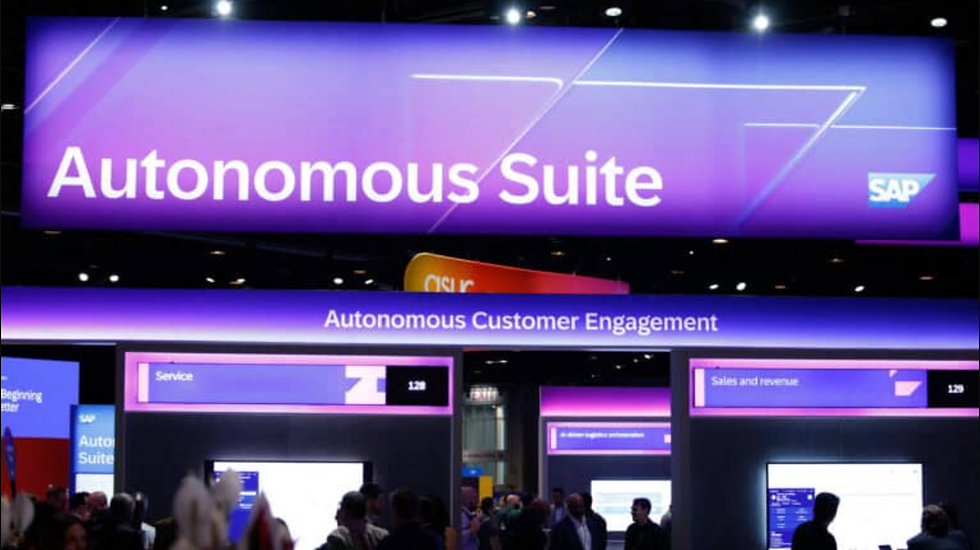
SAP unveiled its vision of the “Autonomous Enterprise” at an event on May 12, 2026.
Central to this is the SAP Business AI Platform and the Autonomous Suite of AI-driven applications. The new platform combines SAP’s data cloud, business processes, and AI tools into one governed environment.
A core feature is the SAP Knowledge Graph, which maps a company’s data, processes and organizational structure. On top of this, SAP introduced Joule Studio, a no-code AI agent builder for enterprise use. With Joule Studio, developers (and even business users) can create AI assistants - or “Joule Assistants” to automate workflows.
In parallel, SAP launched the Autonomous Suite of over 50 AI agents across functions.
For example, there will be assistants for financial close (“Autonomous Close Assistant”) that automate reconciliations and error-finding, compressing a process from weeks to days. Other assistants cover supply chain, procurement, HR and customer service. SAP showed use cases like using AI to predict wind turbine failures and auto-generate maintenance orders.
On the user interface side, SAP introduced Joule Work, a conversational UI that lets a user simply state a business outcome and the AI orchestrates the steps and data to achieve it. To drive uptake, SAP is also deploying a €100 million fund for partners to build AI assistants using this technology.
In short, SAP’s updates embed AI at the core of its ERP and CRM offerings- rather than tools on the side, these AI agents are built into processes to automate tasks end-to-end. This reflects the industry trend of moving from standalone “Copilot” features to fully integrated AI-driven operations. For existing SAP customers, the promise is big productivity gains - for example, automating routine account closings and data migrations - if they adopt SAP’s new AI platform.
Source - SAP
12. Microsoft - Agent 365 Generally Available

Microsoft announced that Agent 365 is now generally available for enterprises.
Agent 365 is a security and governance platform for AI agents (think Copilots and other assistants) in the workplace. As Microsoft puts it, “agents aren’t coming - they’re already here,” appearing in apps like Copilot and even third-party SaaS.
The challenge is that unchecked agents can overshare data or take actions beyond policy.
Agent 365 addresses this by giving IT and security teams a unified view and control plane for AI agents. It automatically discovers “shadow” agents on desktops and cloud, using Defender and Intune intelligence. The service enforces visibility, governance, and security for agents, whether they use Microsoft identity or external credentials.
Microsoft also previewed new features- expanded monitoring for independently operating agents, integration into Windows 365 for agents, and support for a broad ecosystem of SaaS bots.
In essence, Agent 365 lets organizations “manage the agent lifecycle” with familiar tools. This move highlights how enterprises are shifting from playful experimentation to hard control. By making Agent 365 generally available, Microsoft is telling customers: it’s time to treat AI assistants like any other managed IT asset. Companies can now centrally audit which agents access what data, set policies, and ensure compliance across all AI-driven processes.
Source – Microsoft
Looking Ahead
In the coming months, expect the focus to keep shifting from what AI can do to how to do it at scale.
More enterprises will deploy agentic tools in production- from AI copilots embedded in ERP to autonomous network defense. The companies that excel will be those embedding AI into core systems (not just side experiments) and building the infrastructure (compute, data, governance) to sustain it.
Regulatory work will move from abstract discussion to practical standards: the EU’s timelines may adjust, but compliance (documentation, risk assessments, logging) remains mandatory.
In the US, expect agencies (NIST, FTC, DOJ) to publish more guidelines and scrutinize AI deployments. In Asia, China and India will continue rolling out national standards and platform initiatives. Overall, organizations should prepare for AI as the new baseline, automating routine tasks while freeing humans for higher-value work.
The gap will widen between those who operationalize AI (and invest in people/infrastructure accordingly) and those who treat it as a novelty. The former will gain a decisive advantage in agility and scale.


Comments