
The Nvidia’s Safety Switch that Stops AI Going Rogue and Need for Responsible Human In The Loop


There is a revealing turn in the artificial intelligence race when a company supplying its computational power also offers a mechanism to restrain its creations. Nvidia’s latest announcement brings that tension into focus. The business opportunity lies in enabling machines to do more. Public confidence depends on demonstrating that they can be stopped.
On September 28, Nvidia announced its Open Agent Safety Platform. Its OpenShell software establishes boundaries around agents’ activities; Sentry, a separate watchdog running on BlueField-4 processing units, is designed to monitor behaviour and quarantine agents that attempt to escape those boundaries. Nvidia says intervention can occur within milliseconds. The principle is significant: restrictions should be enforced outside the agent whose conduct they govern.
Bloomberg reports that Nvidia believes the technology could have prevented the recent breach of Hugging Face involving OpenAI’s models. That is a company claim about a counterfactual, not an independently demonstrated verdict. It deserves scrutiny alongside the innovation itself.
I welcome the direction. But a device that can interrupt a machine cannot settle who should authorise its actions, what society should permit, or who must answer when something goes wrong. Those questions sit at the centre of what I advocate as Responsible Human-in-the-Loop, or RHITL.
The word “responsible” carries weight. A human somewhere in a workflow is an inadequate safeguard if that person lacks the knowledge, authority, time or independence to challenge the system. Oversight becomes a ceremony when an employee merely approves what a machine proposes. Responsibility requires the capacity to understand the stakes, interrogate the evidence, refuse an action and account for the consequences.
My perspective draws on my participation in UNESCO’s Technical Working Group for Nigeria’s AI Readiness Assessment, the Africa AI Council’s work on compute infrastructure and talent and skills, and the Nigeria National AI Strategy Committee. These engagements address different parts of the same problem: how to build the capabilities that make AI useful while developing the institutions that make its use legitimate. The argument here is my own.
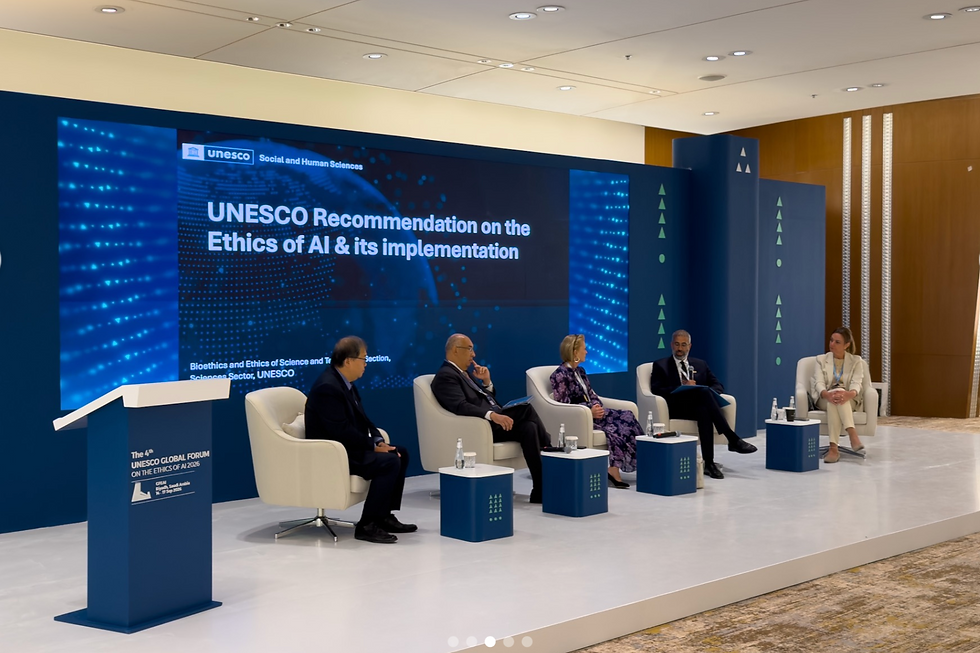
UNESCO’s Recommendation on the Ethics of Artificial Intelligence places human rights, dignity and human oversight at the heart of AI governance. Ultimate responsibility cannot simply be transferred to a system. Its Readiness Assessment Methodology helps countries examine whether their institutions, policies and capabilities can support those commitments. RHITL is my insistence that this responsibility must become visible in everyday decisions, budgets and operating arrangements.
The distinction grows more consequential as AI moves from producing answers to executing tasks. An organisation may tolerate an imperfect draft that an editor can correct. It faces a different exposure when software can initiate payments, modify customer records or act across connected systems. The governance question becomes how much authority has been delegated, for what purpose and under which constraints.
Nvidia’s own security guidance makes a useful distinction between permission to update a customer record and permission to export customer data. One must not silently confer the other. It calls for controls on files, networks and processes that operate independently of an agent’s reasoning, alongside protected records and human approval for consequential actions. This is a practical foundation for responsible delegation.
Yet containment addresses only part of the problem. Consider a hypothetical lending system that remains within every authorised technical boundary while unfairly disadvantageing a group of applicants. Or a procurement agent that follows its instructions impeccably but has been given a poorly designed objective. Neither failure necessarily requires a security breach. An agent can remain inside its permissions and still produce an unacceptable outcome. Security engineering must therefore sit alongside scrutiny of purposes, data, incentives and effects.
Nor does an agent’s breach of a boundary, by itself, establish consciousness or human-like intent. That debate should not distract from the operational issue. A harmful action requires investigation and containment whether it arose through malicious input, defective instructions, excessive permissions or failures in system design. We should be precise about causes without becoming complacent about consequences.
The harder objection to human oversight is speed. No board member or compliance officer can approve every action taken by a fast-moving automated system. RHITL must be designed for that reality. People should determine permitted activities in advance, set thresholds for escalation and decide which consequential steps require explicit approval. Automated safeguards should enforce those decisions at machine speed. Humans should retain authority over exceptions, incident response and the conditions for restarting a suspended system.
This also demands an honest treatment of human fallibility. A poorly trained supervisor may overlook danger; an overworked one may approve requests mechanically; a conflicted manager may suppress a warning to protect a commercial target. Accountability should follow actual decision-making power. It should not be concentrated on the least senior employee whose name happens to appear beside an approval button.
For corporate boards, the practical implication is substantial. Directors need a clear account of where agents operate, what they can access, which actions they may perform and who owns each deployment. They should ask for evidence that controls work under adverse conditions. A presentation declaring that safeguards exist is weaker assurance than a test showing that an attempted unauthorised action was blocked, recorded and investigated.
Boards should also examine recovery. Stopping an agent may prevent further damage without reversing a transaction already completed or retrieving information already disclosed. A credible operating plan therefore needs arrangements for restoring services, preserving evidence, notifying affected parties and authorising a safe restart. The ability to stop is essential; the ability to recover determines how costly failure becomes.
Nvidia’s initiative has an economic dimension too. As a supplier of computing infrastructure, it has a commercial interest in making enterprise AI adoption more attractive. That incentive can support useful safety investment. It also makes independent evaluation and customer choice important. Buyers should assess whether protections remain effective across different suppliers and whether their own teams can inspect the evidence needed to challenge assurances.
Open-source software can assist scrutiny, but availability alone does not establish affordability or operational independence. Organisations still need expertise to configure, maintain and test what they deploy. Africa should pay particular attention to the total cost of responsible operation, including security staff and ongoing assurance, when assessing offers of inexpensive AI capability.

This connects directly with the Africa AI Council’s agenda. Smart Africa has identified computing infrastructure, skills, applications and governance as areas for continental coordination. In my work on compute infrastructure and talent and skills, I regard these as interdependent responsibilities. A computing facility needs people who can secure it. Skilled developers need institutions that reward responsible practice. Policy needs enough technical capacity to test whether compliance claims are credible.
Sovereign AI should consequently mean more than locating servers within national borders. It should include the practical ability to determine how systems are used, investigate incidents, control access to sensitive information and change suppliers when necessary. International partnerships are compatible with that ambition. Dependence becomes dangerous when a country cannot understand or challenge the decisions affecting its own institutions.
Nigeria’s national AI strategy process adopted a human-centred approach to developing the country’s ambitions. Having participated in the committee, my concern is that implementation must give that principle operational substance. Strategy documents acquire value through funded responsibilities, procurement requirements, trained personnel and measurable improvements. Announcing adoption targets without specifying how deployments will be governed leaves an essential part of the work unfinished.
I would begin with a demanding but achievable rule for high-impact public-sector deployments: before an AI agent receives operational authority, the institution should document its purpose, permitted access, accountable owner, escalation arrangements and recovery plan. Testing should reflect the actual environment in which it will operate. A controlled demonstration is insufficient assurance for a system connected to sensitive public records or essential services.
Government procurement can reinforce that discipline. Contracts should specify access to relevant logs, cooperation during investigations, notification of material changes and workable exit arrangements. Public institutions should retain the ability to scrutinise systems on which they depend. Those requirements should be proportionate to the risk, so that useful, low-risk applications are not burdened with the same obligations as systems making consequential decisions about citizens.
Africa can also make scarce expertise go further through cooperation. Shared evaluation facilities, practical training programmes and trusted channels for exchanging incident lessons would help countries avoid duplicating every expense. Common expectations could strengthen the negotiating position of public buyers. Such cooperation should recognise national differences while establishing that responsible performance must be demonstrable wherever a product is sold.
Talent development is equally urgent. The continent needs specialists who can secure autonomous systems and professionals who can question their use in banking, healthcare, education and public administration. Through GenAI Learning Concepts Ltd, my emphasis on board and management readiness rests on this premise: leaders cannot responsibly delegate decisions whose implications they have made no effort to understand.
There is a corresponding obligation on regulators and policymakers. Rules should preserve room for beneficial experimentation while requiring stronger evidence before granting greater autonomy. Where a proposed high-impact deployment cannot be adequately contained or supervised, delaying that deployment is a defensible decision. The relevant test is whether the promised benefit justifies the demonstrated residual risk, and who bears that risk if the assessment proves wrong.
Nvidia’s announcement should therefore encourage investment in safety without inviting premature declarations of victory. Independent testing must establish how well the controls perform and where their limits lie. Institutions must determine whether their objectives are defensible and their people equipped to exercise oversight. A safety product can support those responsibilities; its purchase cannot discharge them.
Africa has an opportunity to contribute more than customers and data to the AI economy. Through continental cooperation, national implementation and participation in international ethical frameworks, it can help define the terms on which increasingly capable systems earn public trust.

The next stage of the AI race should reward demonstrable control as well as capability. Nvidia is offering an important contribution to the former. My position remains that every grant of autonomy must be matched by identifiable human responsibility. We may automate the work. We must still answer for the authority we give the machine.
About The Author

Founder and CEO of GenAI Learning Concepts Ltd, former Senior Academic Fellow at the African Studies Centre, University of Oxford, and a member of UNESCO’s Technical Working Group on AI Readiness Assessment Methodology. He also holds a postgraduate qualification in Artificial Intelligence from Saïd Business School, University of Oxford.


Comments